
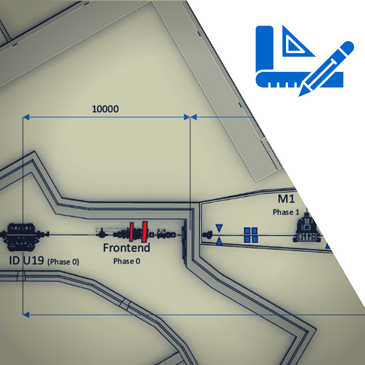
Work has officially started on the MAVKA beamline, carried out by an international team of experts, marking a key milestone in building advanced research infrastructure and strengthening support for the Ukrainian scientific community.
The SOLARIS National Synchrotron Radiation Centre is entering a key phase in the development of the MAVKA beamline — a flagship project under the Light for Ukraine initiative. The project brings together Poland, Ukraine, and Switzerland in a coordinated effort to develop a shared research infrastructure supporting Ukrainian scientists and strengthening the scientific community of Central and Eastern Europe.
The initiative is coordinated under the auspices of the League of European Accelerator-based Photon Sources (LEAPS), which brings together all major synchrotron facilities in Europe and plays a central role in mobilising international support for Ukraine’s scientific recovery.
Since 2022, SOLARIS and the Ukrainian synchrotron radiation users’ community have organised a series of workshops involving more than 500 researchers. These activities have enabled the identification of key scientific priorities and the development of a detailed concept for the MAVKA beamline, ensuring that the infrastructure responds directly to the needs of the Ukrainian research community.
The MAVKA beamline, to be located at the SOLARIS synchrotron in Kraków, is being developed as a shared European infrastructure. The project is the result of close collaboration between Polish and Ukrainian scientists and is being expanded to include partners from across Central and Eastern Europe.
A major milestone in the project has been the support provided by the Paul Scherrer Institute (PSI), including both financial and in-kind contributions. In particular, the delivery of the undulator source — valued at approximately CHF 1 million — and the feasibility studies developed with the involvement of Prof. Luc Patthey have been essential for advancing the project.
Additional funding of CHF 1.5 million has been secured through the Swiss National Science Foundation and the State Secretariat for Education, Research and Innovation (SERI). While this support represents a significant step forward, further funding is required to fully realise the beamline. SOLARIS, together with its partners, is actively engaging with European funding instruments, LEAPS member facilities, and regional stakeholders to build a broader coalition of contributors.
The MAVKA beamline is designed to operate in the soft and hard X-ray regime, offering advanced capabilities for the analysis of materials and chemical processes. Its scientific applications will span key areas such as agriculture, energy, materials science, and biotechnology, supporting both fundamental research and innovation.
Beyond its scientific capabilities, MAVKA represents a new model of shared infrastructure development in Europe. By combining financial, technical, and intellectual contributions from multiple countries, the project strengthens international collaboration, accelerates knowledge transfer, and enhances the efficiency of research efforts across the region.
The initiative also contributes to the long-term integration of Ukraine into the European Research Area by building sustainable partnerships and creating conditions for continued scientific cooperation.
SOLARIS remains open to further international collaboration and actively seeks new partners, particularly from the Baltic and Central-Eastern European regions, to expand the network supporting the development of the MAVKA beamline.