
A shared European infrastructure – MAVKA beamline
About
The MAVKA beamline is a flagship project of the Light for Ukraine initiative and a pilot example of a shared European research infrastructure developed for the Ukrainian scientific community. Built at the SOLARIS synchrotron, the beamline combines advanced scientific capabilities with a coordinated European investment model, bringing together financial, technical, and institutional contributions from international partners.
As a joint contribution of European photon (LEAPS) and neutron (LENS) research infrastructures, MAVKA supports the objectives of the international coalition established by the European Commission, providing a coordinated infrastructure-based component for Ukraine’s scientific recovery.
The MAVKA beamline represents the first infrastructure of this kind to integrate Ukraine into the European Research Area at such an advanced level, operating under open access and scientific excellence principles established within ESFRI and ERIC frameworks. As a result, the project not only delivers new experimental capabilities, but also creates a long-term mechanism for Ukraine’s participation in the European research infrastructure ecosystem.
beamline USER model
European fundraising for open access
The development of MAVKA is driven by a coordinated European effort to mobilise resources and expertise in support of Ukraine. Through science diplomacy, Light for Ukraine engages research infrastructures, governments, and funding bodies to build a coalition of partners contributing to a shared investment model.
This distributed funding approach, based on European donations and in-kind contributions, demonstrates how joint action can deliver high-quality infrastructure while ensuring long-term sustainability and institutional trust. The involvement of partners such as the Paul Scherrer Institute (PSI) illustrates the effectiveness of this model in securing both financial and technical support.
The MAVKA beamline will operate under an open access model, ensuring that access to experimental time is based on scientific excellence. Following established European practices, beamtime allocation will balance access for contributing partners with open calls for the broader scientific community, supporting both collaboration and competitiveness.
MAVKA beamline will support a wide range of scientific fields, including:
The ability to perform experiments under realistic conditions will enable research directly relevant to societal and technological challenges.
MAVKA Scientific capabilities and technical overview
The MAVKA beamline is designed to provide a broad range of advanced spectroscopic techniques for the analysis of materials across multiple disciplines. The beamline will operate in a wide energy range from soft to hard X-rays (0.5–9.0 keV), enabling experiments under diverse and realistic conditions.
It will support studies of solid and liquid samples using techniques such as photoemission, absorption, and fluorescence spectroscopy, allowing for precise investigation of chemical composition, electronic structure, and material properties.
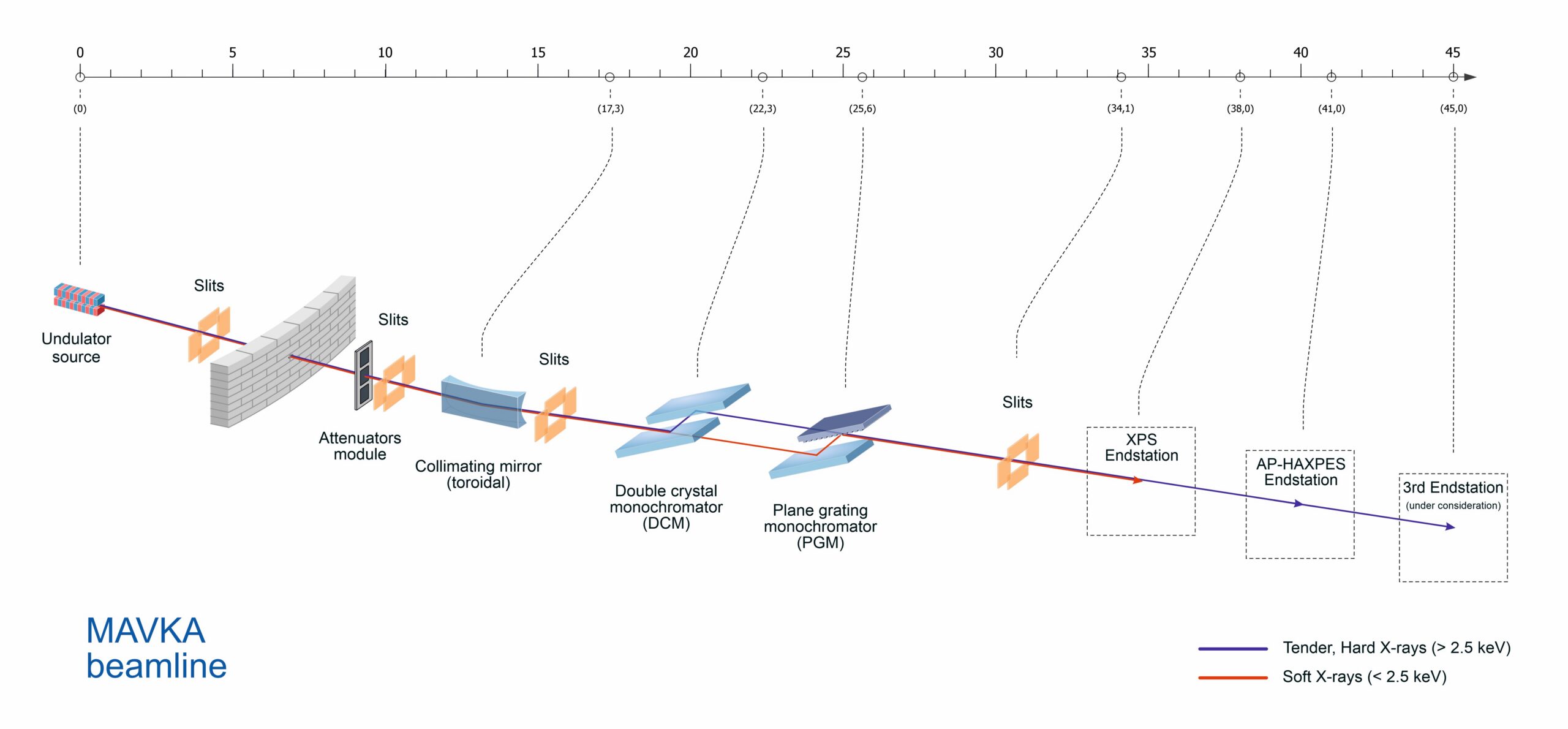
MAVKA is based on an in-vacuum U19 undulator source, delivering high-intensity X-ray radiation with a photon flux of approximately 10¹¹ photons per second at the sample.
The beamline will include advanced optical components such as a double crystal monochromator (DCM) and, in its second phase, a multilayer monochromator (MGM), enabling coverage of both hard and soft X-ray regimes.
Focusing optics based on Kirkpatrick–Baez mirrors will provide micrometre-scale beam size at the sample position, supporting high-resolution measurements.
The beamline will host two complementary endstations:
XPS/XAS endstation
Enabling µ-XPS, µ-XAS and µ-XRF techniques for high-resolution surface and chemical analysis, supported by an ultra-high vacuum environment with cryogenic capabilities.
AP-HAXPES endstation
Designed for studies under near-ambient conditions, allowing investigation of solid–liquid and solid–gas interfaces, as well as in-situ and operando electrochemical processes.